
Edited by:
redazione
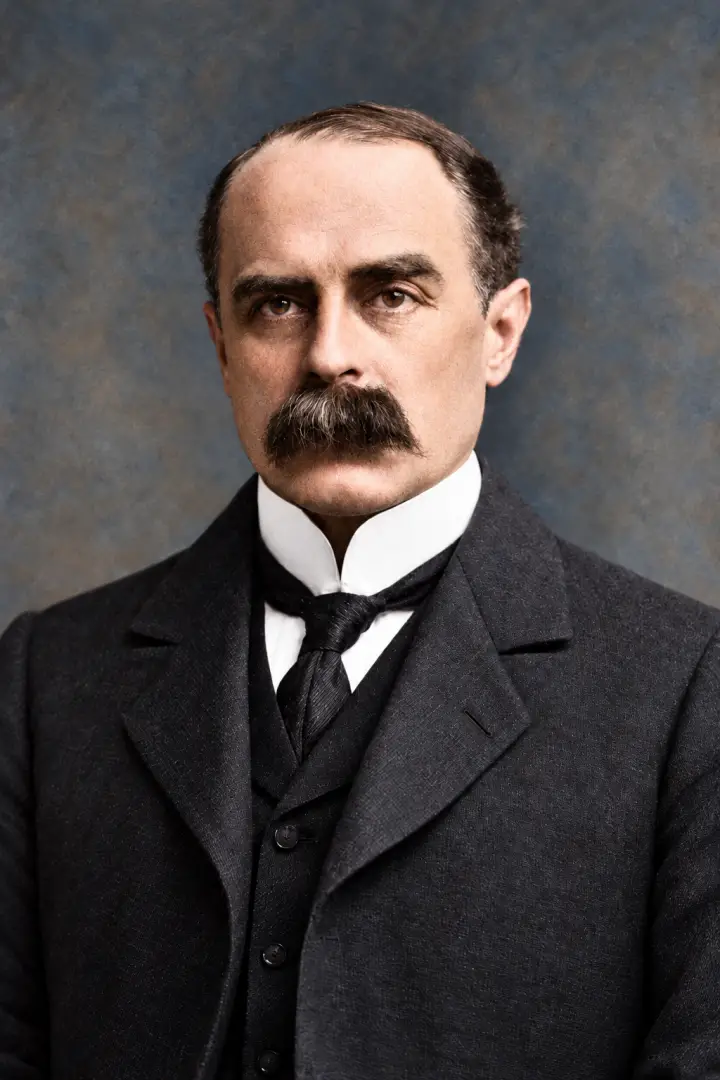
A British explorer and officer, he led the 1903–1904 expedition to Tibet.
Personal details
Name: Francis Edward Younghusband
Date of birth: 31 May 1863 - Murree, British India (now Pakistan)
Died: 31 July 1942 - Lytchett Minster, Dorset, England
Nationality: British
Occupation: officer, explorer, civil servant, writer
Affiliation: Royal Geographical Society (President 1919–1922)
Biography
Francis Edward Younghusband was born in Murree, in the Punjab region ofBritish India, into a family with links to the army: his father, John William, was a general, and his mother, Clara Jane Shaw, was the sister of the Central Asian explorer Robert Shaw. He studied at Clifton College in Bristol and at the Royal Military College, Sandhurst, and in 1882 joined the 1st King’s Dragoon Guards, a regiment stationed in India.
He used his leave from service to undertake his first exploratory journeys. His 1886–1887 expedition, from Manchuria to Kashmir via the Gobi Desert and the Karakoram, earned him the Royal Geographical Society’s Patron’s Medal in 1890; he had been a Fellow of the Society since 1888. He then moved into the civil service in British India, taking up posts on the northern frontiers of Hunza and Chitral, at a time when the rivalry between the British Empire and Russia overCentral Asia – the so-called Great Game – was driving much of the reconnaissance in that region.
In 1903, he was appointed head of the British political mission sent to Tibet to secure negotiations and trade guarantees. The military escort, commanded by General James Macdonald, transformed the mission into an armed campaign that reached Lhasa, where the Convention between Great Britain and Tibet was signed on 7 September 1904. Sources from the period refer to a mission or expedition to Tibet; subsequent historiography has also used the term ‘invasion’, which appears in the subtitle of Peter Fleming’s 1961 work. The most controversial episode was the Battle of Guru on 31 March 1904, in which Tibetan casualties far exceeded those of the British. Younghusband imposed conditions on Lhasa that were more severe than those the government in London was subsequently prepared to endorse, and some clauses were disavowed.
Younghusband himself recounted that, immediately after leaving Lhasa, whilst on a hillside, he experienced an intense sense of joy and oneness with all things. From a documentary perspective, this is his own account, given in later writings. Religious experiences had already been recorded in the 1890s, and his biography cannot be reduced to a conversion from imperialism to pacifism: his imperial convictions did not disappear immediately, and his subsequent thinking gradually shifted towards the idea of a spiritual reality common to the various religions.
Following his appointment as British Resident in Kashmir in 1906, he left the Indian service between 1909 and 1910 (his retirement was formalised in May 1910 [to be verified]). In 1897, he had married Helen Augusta Magniac; their daughter Eileen (1902–1981) became a leading figure in British social work. President of the Royal Geographical Society from 1919 to 1922, he played an institutional and organisational role in the early British expeditions toEverest: he chaired the committee that organised them and made use of the Tibetan permit for access from the north obtained in early 1921. He did not take part as a mountaineer. There were three expeditions, in 1921, 1922 and 1924.
In 1936, he organised the congress in London that gave rise to the World Congress of Faiths, which recognises him as its founder. The stated aim was not a syncretic religion, but mutual understanding amongst members of different faiths. On 17 July 1942, he delivered the opening address at the movement’s final conference, in Birmingham, in which he took part. After falling seriously ill, on 21 July he was taken to Lytchett Minster, to the home of Lady Madeline Lees, where he died on 31 July. He was buried in the cemetery of the village parish church, in a grave bearing a depiction of the Himalayan mountains.
Mountaineering exploits
Manchuria (China) – 1886–1887 – expedition with H. E. M. James
Gobi, Hami, Kashgar, Yarkand – 1887 – crossing from China toIndia
Muztagh Pass (Karakorum) – 1887 – passage from Chinese Turkestan to Kashmir via a pass that was then uncharted
Hunza and Pamir – 1889–1891 – missions and reconnaissance; in 1889, a meeting with the explorer Bronisław Grombczewski; in 1891, expulsion from territory claimed by the Russians
Tibet (as far as Lhasa) - 1903–1904 – political mission with a military escort, concluding with the Convention of 7 September 1904
Works
The Relief of Chitral, London, Macmillan, 1895 (with George John Younghusband)
The Heart of a Continent, London, John Murray, 1896
Kashmir, London, A. & C. Black, 1909
India and Tibet,?], 1910
Within: Thoughts During Convalescence, ?, 1912
The Epic of Mount Everest, London, Edward Arnold, 1926
Modern Mystics, ?, 1935
A Venture of Faith, ?, 1937
Bibliography
As a writer
not found: no critical study dedicated to his written work
As a significant reference
George Seaver, Francis Younghusband: Explorer and Mystic, John Murray, 1952
Peter Fleming, Bayonets to Lhasa: The First Full Account of the British Invasion of Tibet in 1904, Rupert Hart-Davis, 1961
Patrick French, Younghusband: The Last Great Imperial Adventurer, HarperCollins, 1994
Marcus Braybrooke, A Wider Vision: A History of the World Congress of Faiths, 1936–1996, Oneworld, 1996
Charles Allen, Duel in the Snows: The True Story of the Younghusband Mission to Lhasa, John Murray, 2004
Wendy Palace, The British Empire and Tibet 1900–1922, Routledge, 2005